It took me a while to realize that my new pen pal, Hironobu Kagae, is an emerging lifestyle guru. He and I met on Instagram: I sent him a message admiring his entryway and we struck up a halting conversation. I don’t speak Japanese and Hironobu was relying on Google Translate. But he shared intriguing photos of his family home and rural life at the southernmost tip of mainland Japan, and everyone at Remodelista was immediately hooked.
Hironobu and his wife, Hitomi, have three kids and live in a village in Kagoshima prefecture. He works for Sinken, a building company specializing in environmentally friendly custom wooden houses—”we look for ways to satisfy both people and nature,” explains the website. Hironobu might have written that himself—it turns out he’s a columnist on the Sinken site, and by making use of Google Translate myself, I came to learn a lot more about Hironobu’s own story; his practical, unpretentious approach to design; and his celebration of everyday pleasures, such as “sitting by a window and calmly catching the air at the beginning of the day.”
A nutshell bio: To avoid the forbidding high school admissions test, Hironobu attended technical high school where he studied interior design—then went on to earn a newspaper college scholarship and a master’s degree in architecture, all while delivering papers for 14 years (he started in fifth grade). It was touring a Sinken design that inspired him to work for the company—which entailed moving with his family three hours south to the countryside. In Kagoshima, he was able to buy a triangle of land and build his own work-in-progress compound, pet goat, oak forest, and newly planted rice field included.
Hironobu’s home chronicles—on the benefits, for instance, of having a communal closet and family bath right next to the laundry area (the title of that essay is “A house that makes housework easier”) —have been so popular that he’s just published his first book, The Meaning of Living, which he described for me as “an essay on what I thought about when designing and building my own home and my daily life.” Join us for a tour via the Kagae family album.
Photography by Hironobu Kagae (@kagae_hironobu).

Above: A Japanese maple (here in its fall glory) stands outside the front door. Of his design, Hironobu writes, “I prepared a box (a simple wooden house) that suited the lush greenery of the area.” It was constructed by the team at Sinken and incorporates signature Sinken elements, such as wood-framed windows and a heat-collecting pitched metal roof that works in tandem with external insulation and an under-floor heating system.,
Above: The laminated cedar structure is left exposed, as is the Sinken way—”we use natural materials and avoid plasterboard, which is in about 95 percent of Japanese homes,” says Hironobu. “The interior walls are a traditional Japanese building material called
moiss, which is made of lime and pulp. It’s another structural material that we use as a finishing touch.”
The framework is cleverly put to use as entry storage courtesy of a wooden overhead rack (see our 10 Easy Pieces on Train Racks). Hironobu’s book publisher quotes him as saying he built the house with “the desire to spend every day with peace of mind and kindness.”

Above: The structure is compact (for togetherness and longterm use) and the downstairs has an indoor-outdoor open flow. In addition to the structural supports, the ceiling and floors are locally grown cedar and the paneled wall in front of the Christmas tree is oak (it fronts the multi-purpose Japanese Room—scroll to the end to see the floor plans). The Kagaes celebrate Christmas as a secular holiday: “Santa Claus brings presents for the children and we enjoy a luxurious dinner.”,
The collapsible Nychair X Lounge on the deck is a Japanese design classic from the 1970s.

Above: In the winter it snows on occasion and the under-floor heating is supplemented by a wood-burning stove. The furnishings are a mix of vintage pieces and Hironobu’s own creations (he built the wooden daybed) and get shifted around with the seasons. Hironobu says the house is designed for ease of use, longevity (he hopes he and Hitomi will be here long after their children have left the nest), and close connection with the outdoors—after living in the countryside for two years, he moved the TV out of the living room in favor of playing music and taking in the views.
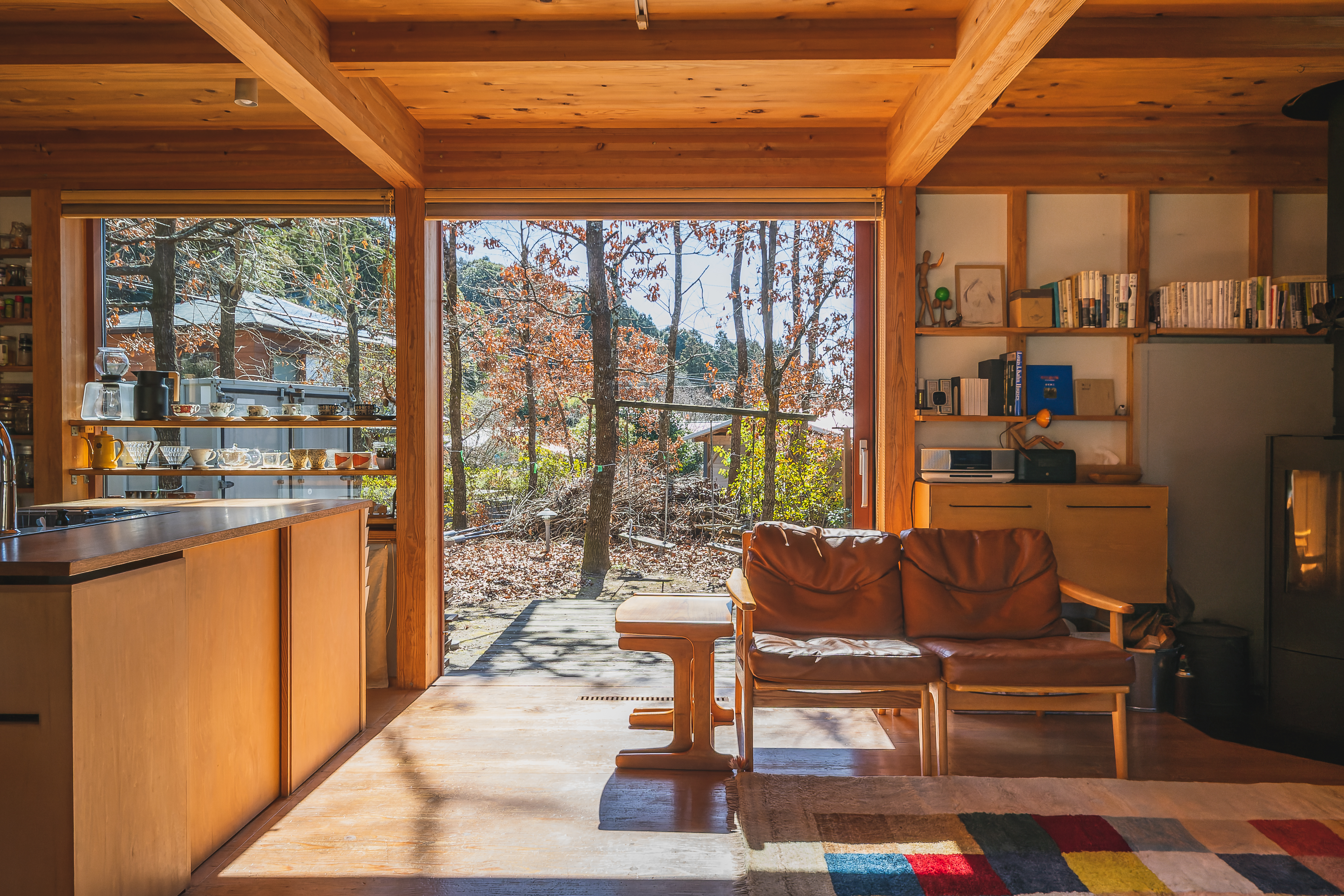
Above: There’s a compact kitchen at the other end of the living room with custom cabinets of Japanese linden plywood. The Danish leather settee is a thrift store find.

Above: When the family’s coffee supplies proliferated, Hironobu built the window shelves using leftover wood—he writes on the Sinken site, “if you look closely, you can see that the shelf supports are made of hardware or pieces of wood…it’s quite rough.” The island has an oak counter and a sink with an inset drying rack.,
Above: The family’s new kitchen table—a midcentury design by Scottish maker A.H. McIntosh—is surrounded by a hodgepodge of chairs. Hironobu recently switched to the round design to make group conversation flow easier. The light is a vintage Gubi Semi Pendant.

Above: Previously, the family had a rectangular oak table and benches that Hironobu built himself using a metal base purchased online. The size, he notes, was “carefully considered, so it could be used in various places and orientations.”

Above: In the warm weather, the daybed gets moved against the large kitchen window and the dining table is shifted into the living area.,
Above: In summer, the daybed overlooks the newly planted rice field. Since building the house, Hironobu has discovered a love for DIY projects and for tinkering: he built the deck and with Hitomi put up a shed for their tractor, among other things; a tool shed and chicken coop are next. “An accumulation of small happinesses becomes every day,” writes Hironobu, “and every day becomes life.”

Above: The upstairs landing offers another entrancing view and is used as a place for lounging and reading.

Above: The son and two daughters share a room that extends across the eastern side of the house with private areas for each: there’s a lower bed, two platform beds, and three built-in desks, all constructed by Hironobu. The family TV is now here.
Above: During last year’s winter holidays, Hironobu built this second floor balcony using cedar from the flooring company Hitomi works for. And he recently recruited his kids to repaint the houses’s exterior with him—it’s finished with a water-repellant black paint.,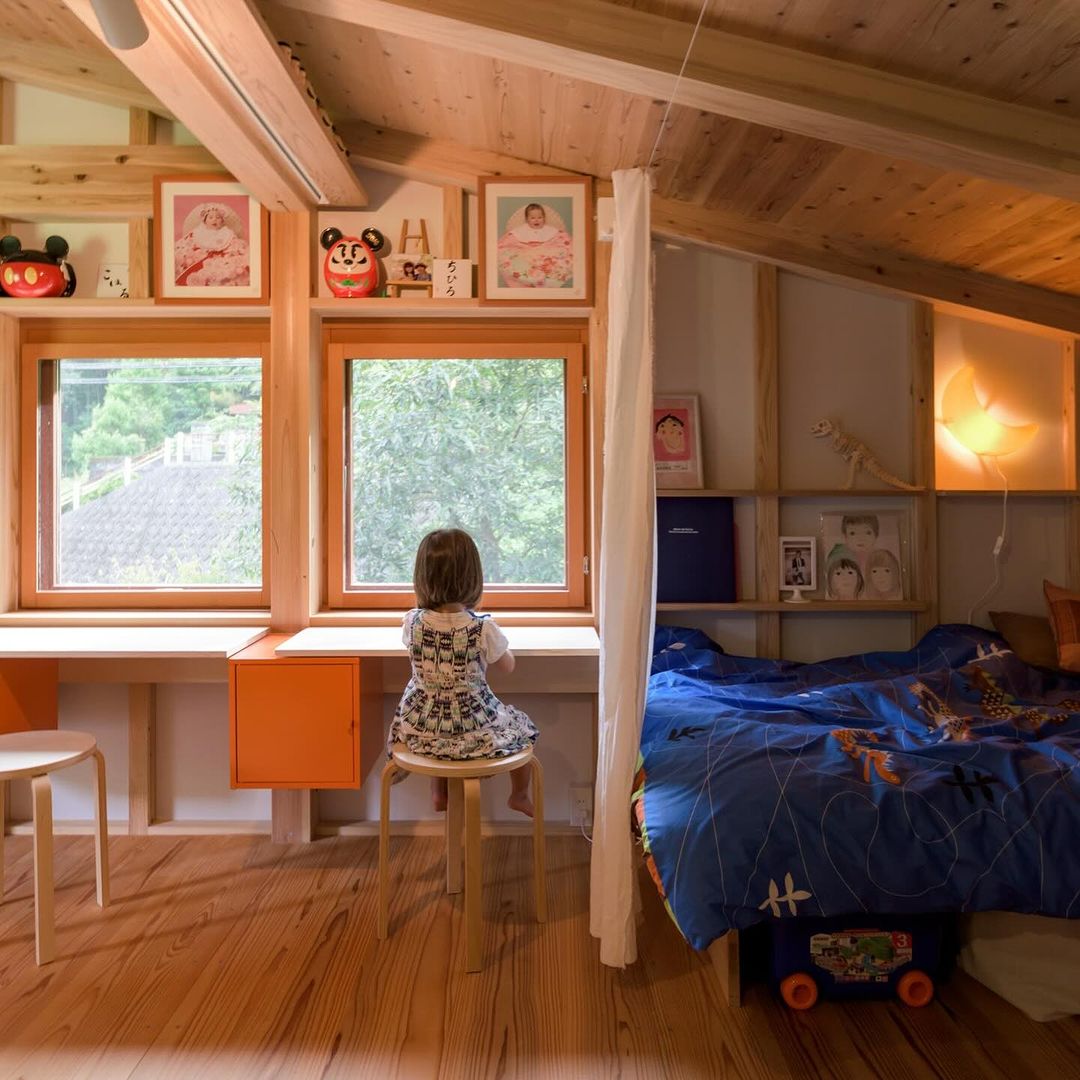
Above: Each child has a private sleeping and study area.
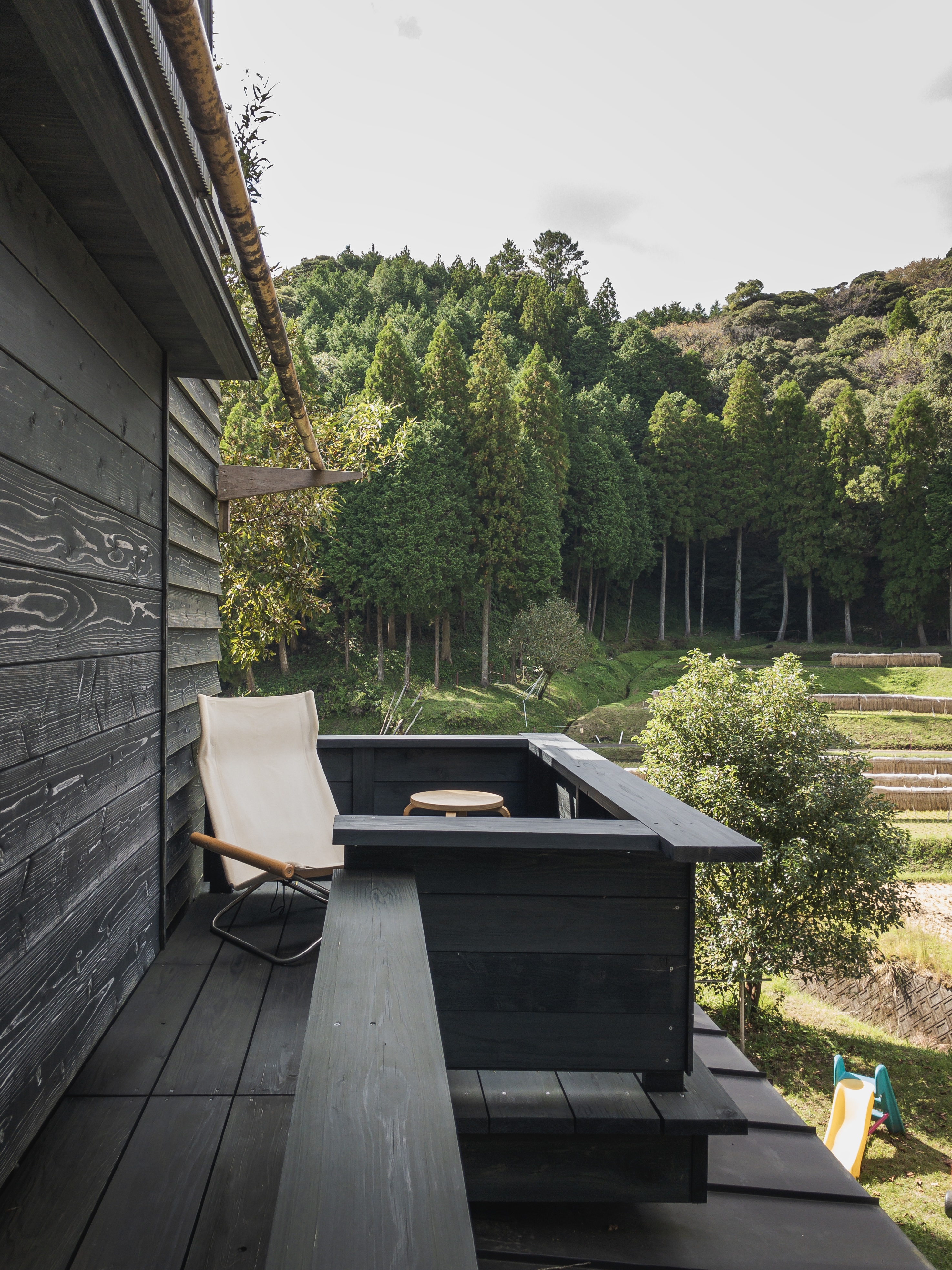
Above: During last year’s winter holidays, Hironobu built this second floor balcony using cedar from the flooring company Hitomi works for. And he recently recruited his kids to repaint the houses’s exterior with him—it’s finished with a water-repellant black paint.

Above: The deck and benches are another DIY project. “A cool house, a luxurious house, a beautiful house… that’s all good,” writes Hironobu, “but I think the best thing is to be able to have a good time with your family.”
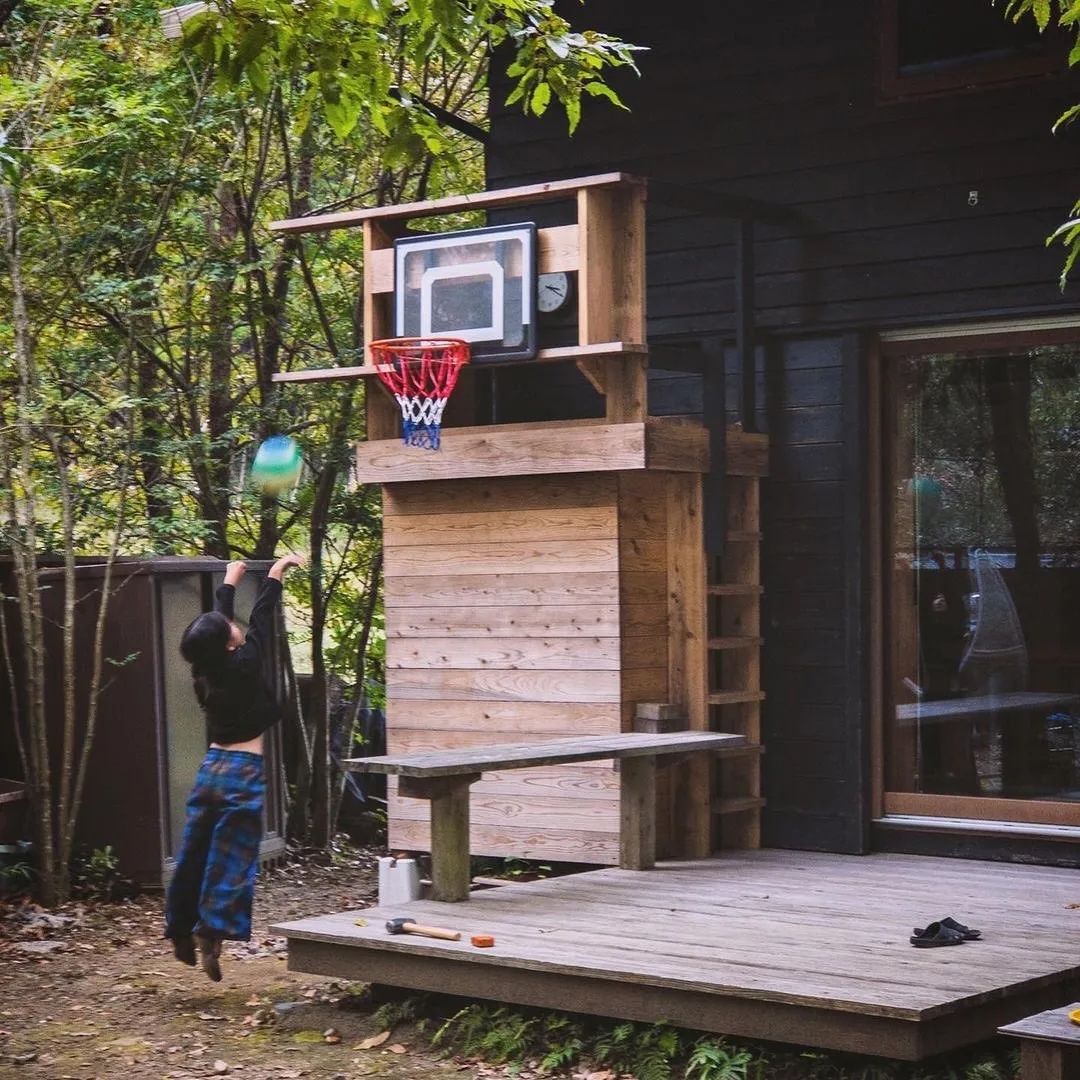
Above: Hironobu’s daughter tests his newly finished basketball setup. That’a a play area platform behind the hoop with a storage closet beneath it—the hoop was “added on a whim.”,
Above: “When the life of a person and his or her family is reflected in their house, I believe that an indescribable depth and attachment is created,” writes Hironobu.
Floor Plans

Above: The living and dining areas shift with the seasons—for better views and temperatures. The tatami-matted Japanese Room has under floor storage—it’s where the guest futons, camping equipment, and kiddie pool goes. Note that the only first-floor space with a door is the tiny WC off the kitchen.

Above: Parents’ and kids’ rooms are upstairs as is the aforementioned family bathroom (traditionally located downstairs in Japanese houses), shared closet, and laundry. Note the adjacent tiny house: that’s another new project. Stay tuned: we’ll be featuring it later this winter.
Here are three more favorite houses that architects designed for themselves:
- Head for the Hills: Two NYC Architects Design Their Own Passive House, Vipp Kitchen Included
- Ca’Giovanni: An Architect’s (Gentle) Renovations of His Great-Grandfather’s Work
- The New Starter House? An Architect Designs a Home That Can Move With Its Owners