Joris Van Apers grew up amid rescued marble mantels, parquet flooring, and stacks of old tiles: his parents ran a busy Belgian salvage business. Joris went on to study engineering, but when he set out to build a house for himself and his wife and kids, he put the family materials to use—and discovered a new career along the way.
Joris ended up taking over the reclamation firm in 2008 while also establishing himself as an interior designer specializing in “applying noble materials to distinctive, playful ends.” His joint venture, Joris Van Apers, supplies Axel Vervoodt among others, with rescued materials, and has a staff of five working on design projects, which now account for the majority of the business.
Located in the town of Reet, just south of Antwerp, the studio occupies the 17th-century French farmhouse that Joris’s father, Andreas, relocated, piece by piece, from Normandy 40 years ago. The impressive setup has long served as an office and showroom—except for the tiny, after-thought-of-a kitchen, which dated from the 1980s and was accessible only by walking through someone’s office. To remedy that, Juris just-unveiled his glam reinvention of the space, which is now both old and new, and even shiny and blue.
Photography by Jan Verlinde courtesy of Joris Van Apers (@jorisvanapersstudio).
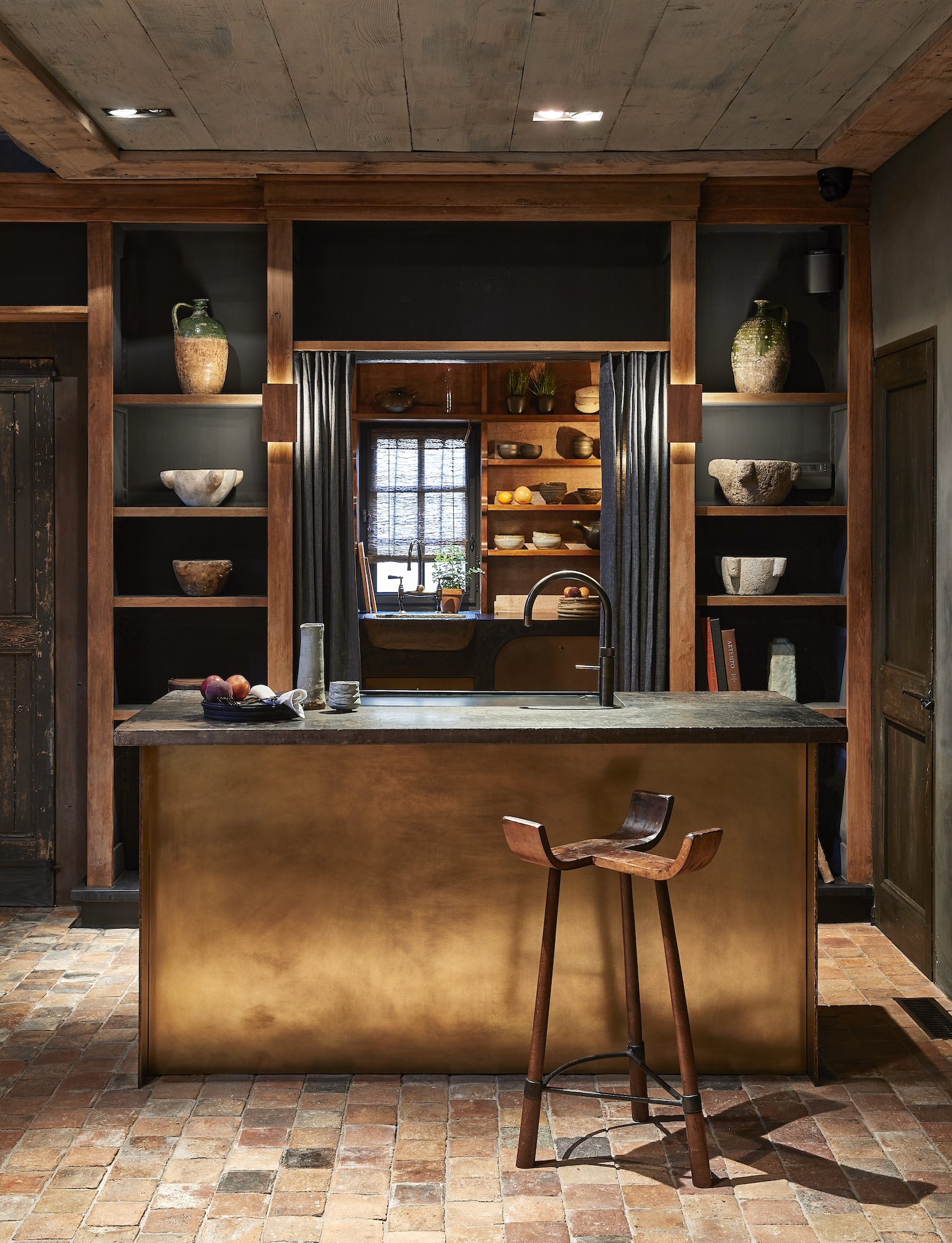
Above: The design melds centuries-old elements with contemporary sensibilities: that’s brass fronting the new bar and the curtained partition offers direct access to the kitchen (which occupies the old kitchen’s footprint). The floor is lined with 17th century French terracotta tiles and reclaimed Italian nut wood was used for the bar countertop and open shelves. The oak stool is a 1960s Belgian Brutalist design.
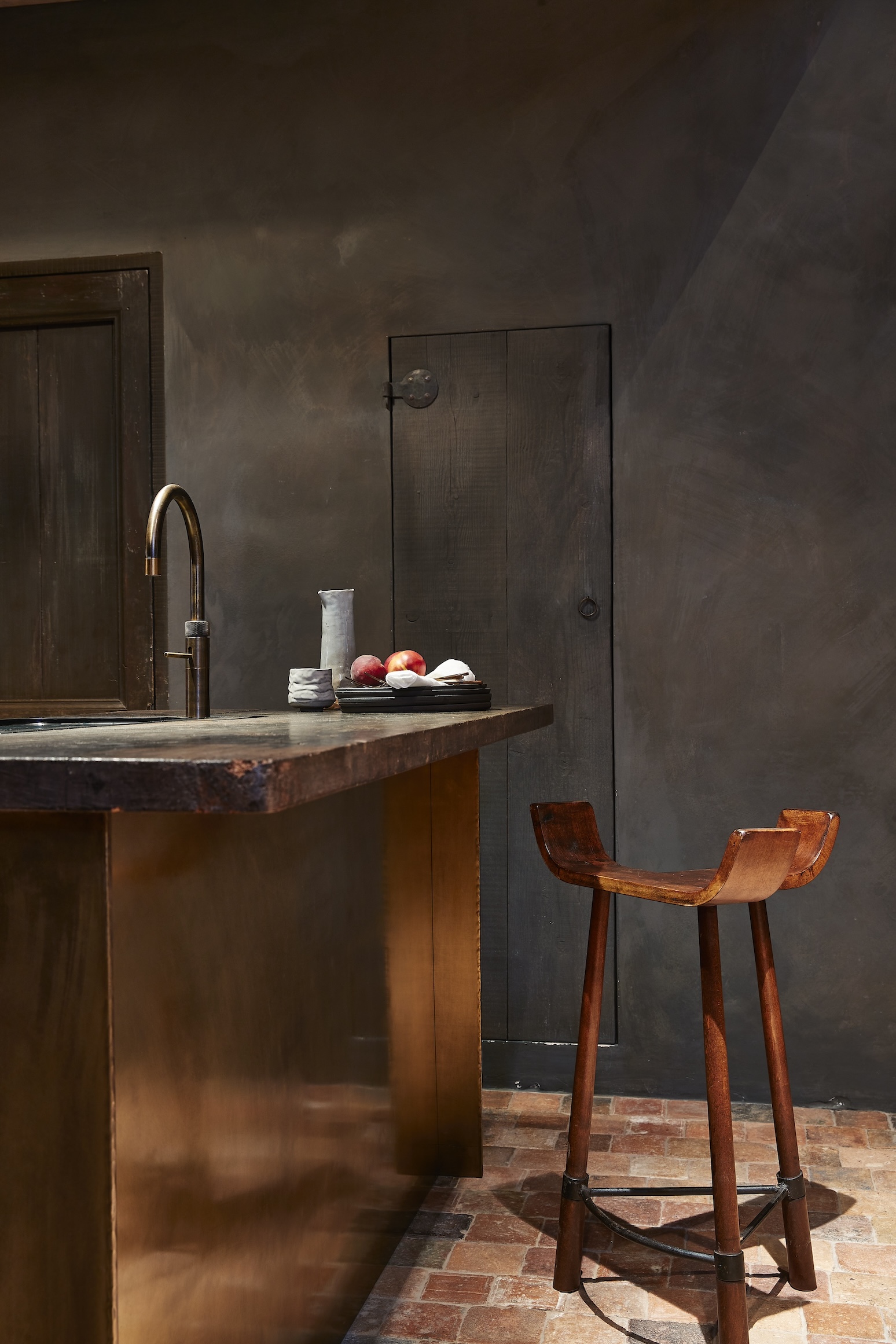
Above: Joris describes the design as an exploration of “materials with various textures, and of shadow and light.” The walls are painted with limewash in an atmospheric brown, shown here, and gray-blue on the back wall. Caroline De Wolf, CFO of the company and Joris’s wife, explains, “our painter mixes pigments on site to achieve the colors we want.” The narrow wood door fronts the utility closet.,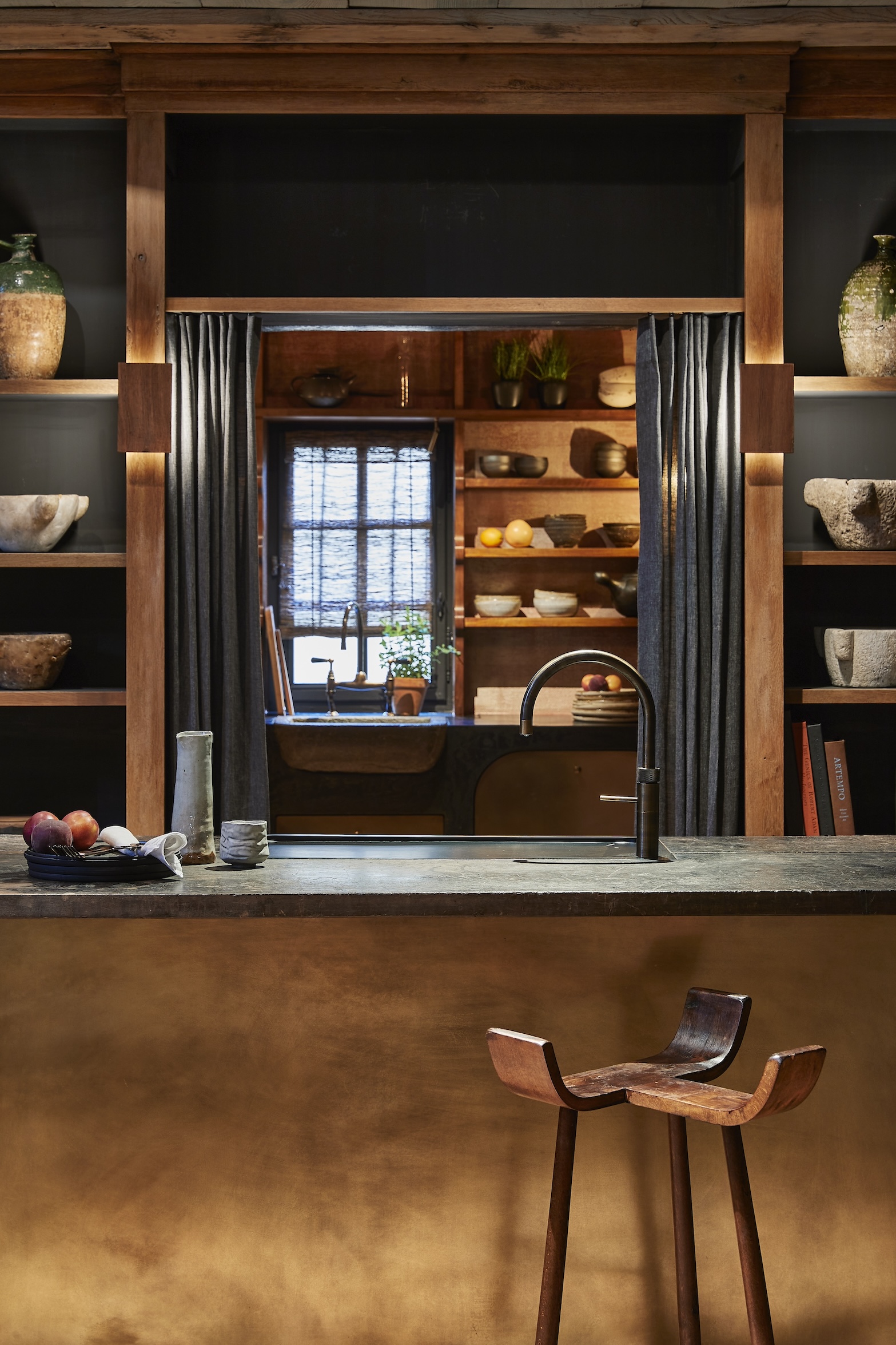
Above: “We like the idea of a kitchen island/bar where we can drink a coffee together or have a quick look at building plans with clients,” says Caroline. The sink is black slate and the faucet is a Quooker, a Dutch system that offers filtered cold, hot, plain, and sparkling water, all from a single tap. (We’re waiting for it to become available in the US.) There’s a drinks fridge behind the bar. The shelves display a collection of Northern Italian antique stone mortars that are for sale.
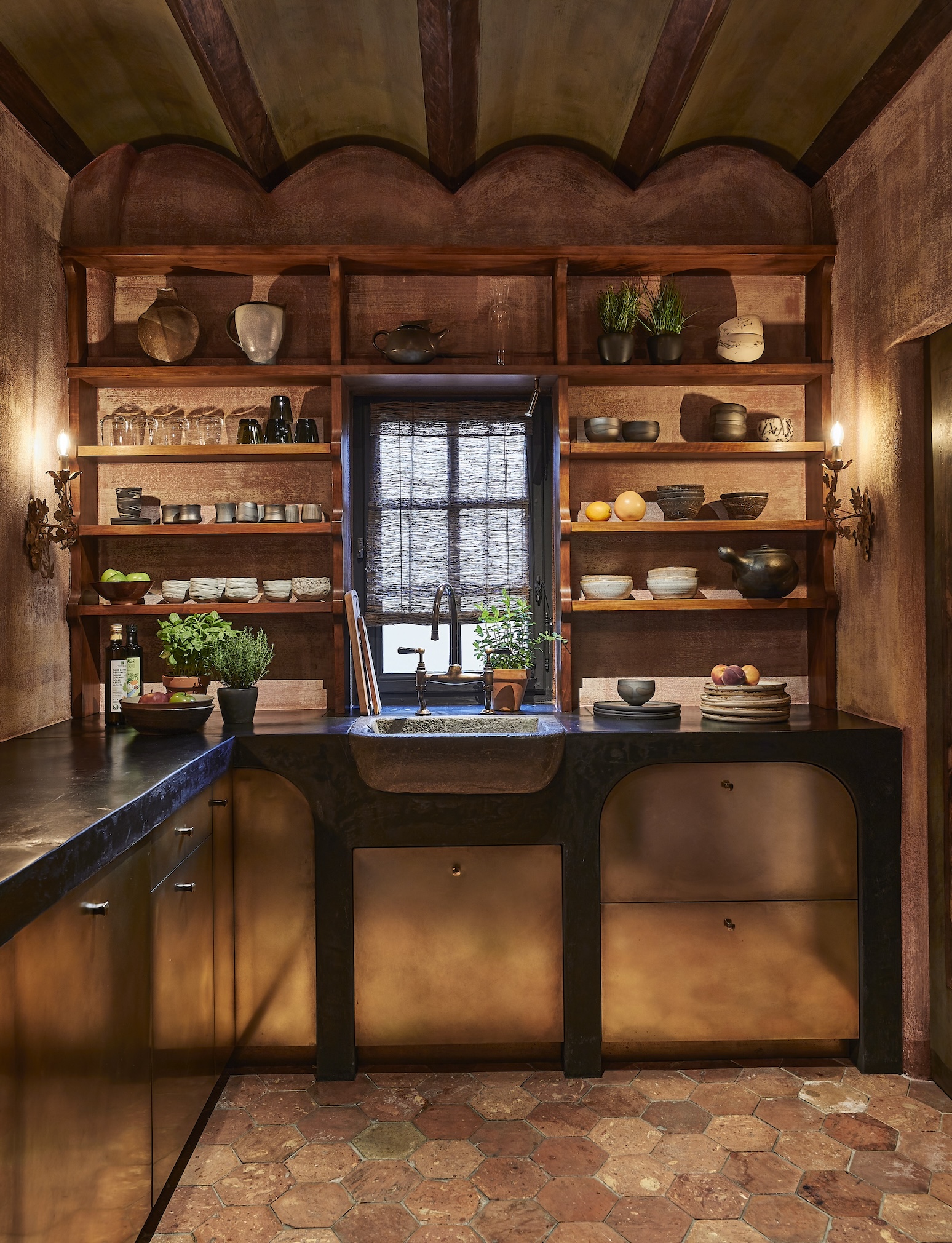
Above: Joris’s experiment with brass continues in the kitchen: the patinated cabinet fronts are incorporated into a wooden framework finished with Mortex black microcement and seamlessly topped with a black slate countertop. The reclaimed hexagonal floor tiles are 17th century French. The vaulted ceiling is original to the house.
It’s an office kitchen, so there’s a coffee machine, fridge, dishwasher, and microwave (all on the back wall just out of the picture), but no stove.
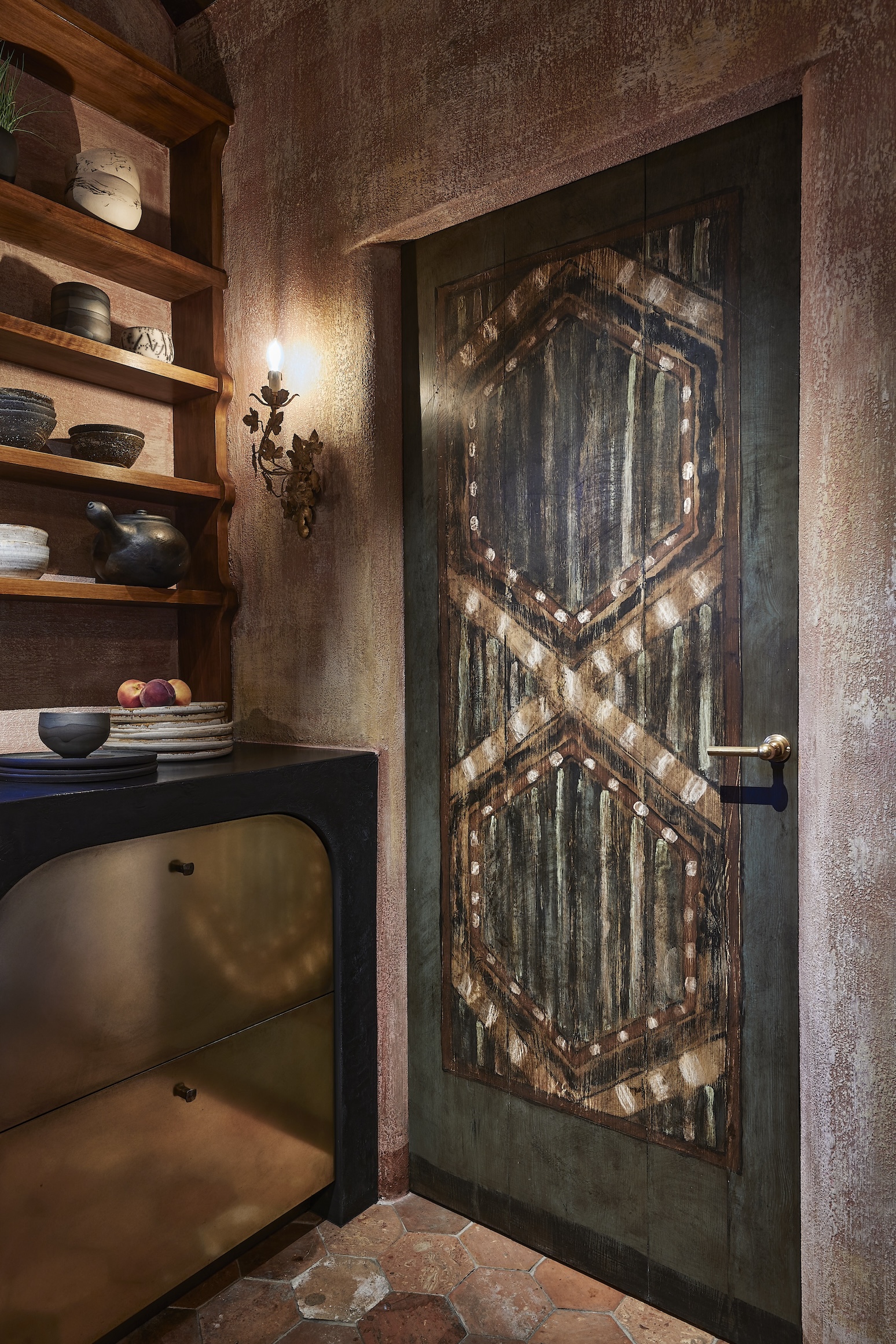
Above: The pattern on the door (to a maintenance room) was inspired by reclaimed Italian painted doors that the firm used in a client’s house—since they no longer had an original, the studio re-created the look. The kitchen’s stone walls are finished with Mortex to create a multi-toned, rough texture. The antique Belgian sconces are supplemented by ceiling lights.
More kitchens that make good use of salvaged materials:
- A Designer’s Deconstructed Sonoma Kitchen from Reclaimed Parts
- The Recycled Content Kitchen in Brooklyn
- An Artful Kitchen Created from Reclaimed Ikea Components, Extreme Budget Edition